

Commentary
In an interview, Marc Lynch discusses his new book decrying the post-1990 U.S.-dominated order in the Middle East.
Michael Young
Source: Getty
The U.S.-Iran war has crossed a dangerous threshold: water infrastructure in the Gulf is now a target. Ecological statecraft is no longer peripheral to security, it's part of its foundations.
The 2026 U.S.-Iran war is radiating through the Gulf’s energy systems, maritime routes, supply chains, food corridors, financial flows, and regional diplomacy—and its effects will be long-lasting. In energy markets, the war is accelerating demand toward more autonomous sources like renewables. On food, the world is bracing for a compound crisis: a convergence of disrupted fertilizer supply chains, inflationary pressures, and El Niño–induced crop failures. These are cascading trends that will demand sustained attention for years to come.
But one long-tail effect has already slipped out of view. The war has crossed a dangerous threshold: Infrastructure essential to civilian survival, including desalination facilities, has been directly targeted. Water infrastructure is emerging as a strategic target in kinetic warfare against a background of structural scarcity.
This marks a qualitative shift in the Gulf’s security landscape. In a region defined by extreme aridity, collapsing groundwater reserves, and deep structural dependence on manufactured water, desalination infrastructure is not merely a technical utility; it is part of the region’s survival architecture. Millions depend on a relatively concentrated set of energy-intensive coastal plants for drinking water, industry, and urban continuity. The exposure of this infrastructure reveals that ecological fragility and military escalation are no longer parallel crises: They are becoming fused within a single battle space.
The significance of this shift extends beyond the immediate conflict. The region is already entering a period in which climate volatility, hydrological breakdown, economic diversification, and geopolitical reconfiguration increasingly interact. Across the Gulf and its neighborhood, temperatures are rising at roughly twice the global average rate, groundwater reserves are being depleted at dangerous speed, and extreme hydrometeorological events are becoming more frequent and more destructive.1 These ecological pressures were already undermining agricultural viability, labor productivity, infrastructure reliability, and political stability before the war. The conflict is now accelerating these vulnerabilities in real time.
This means that water now sits decisively at the intersection of military, economic, human, and climate security. The targeting of desalination plants shows that military strategy is increasingly capable of exploiting ecological and infrastructural fragility for coercive effect. In the Gulf, modern warfare is no longer directed only at military assets or energy facilities. It is also moving against the integrated civilian systems—water, electricity, ports, logistics, and coastal infrastructure—that sustain everyday life and state legitimacy. This is a new threshold of systemic warfare against civilian infrastructure under conditions of climate stress.
In other words, the war is partly rooted in ecological degradation—not in a reductive sense, as geopolitical rivalries, ideology, external actors, and strategic miscalculation all played roles in its beginning, but the ecological preconditions made the conflict more probable, more explosive, and more difficult to contain. Recognizing this is not an academic exercise. It is a prerequisite for designing stabilization responses that can work. Responses that treat the war as a purely political or military event, detached from its ecological substrate, will produce ceasefires that do not hold and reconstruction plans that regenerate the same conditions of fragility. The targeting of desalination plants—a deliberate act of weaponizing ecological vulnerability—makes this logic impossible to ignore.
The strategic implication is clear: Stabilizing the Gulf now requires more than conventional deterrence, crisis management, or technical adaptation. It requires addressing the structural vulnerabilities that make societies brittle in the face of both war and climate disruption. Water is therefore not a secondary environmental issue but a foundational entry point for regional stabilization, long-term de-escalation, and a future security architecture.
To that end, this paper proposes an alternative approach based on complex regeneration. This concept encapsulates the need to intertwine political dialogue with ecological regeneration processes at scale with a view to catalyzing new security dynamics. Given current circumstances, initial steps to contain kinetic escalation should include efforts between the warring parties to design explicit redlines against the targeting and weaponization of water infrastructure. This priority should be quickly accompanied by de-escalation efforts that use water-related insecurity and complex regeneration as a pathway for dialogue.
At a technical level, complex regeneration demands the implementation of ecological interventions at scale to reconnect atmospheric moisture flows with aquifer recharge, the stabilization of soil-water systems, and the rebuilding of regional hydrology. In doing so, this approach provides more than technical benefits: It creates a platform for diplomatic engagement that sidesteps zero-sum bargaining over scarcity. Instead of negotiating the division of a declining resource base that automatically creates vulnerabilities and weaponization opportunities, states and private-sector actors coordinate to expand and stabilize these resources. In this model, regeneration becomes a vessel for dialogue, and mediation becomes a tool for ecological intervention, rather than merely a forum for dispute management, while ecological action becomes a vehicle for confidence building, transparency, and de-escalation.
This paper puts forward a regenerative cooperation architecture built on six pillars:
Such a framework aligns with long-term regional and extraregional incentives. For Gulf states, hydrological regeneration supports food security, energy efficiency, coastal resilience, and labor productivity in extreme heat environments. For Iran and Iraq, it addresses groundwater collapse, agricultural stress, displacement, and political instability. For external actors—including the European Union (EU)—it aligns with climate diplomacy, industrial decarbonization, carbon removal, and infrastructure export strategies.
Despite appearances, the Gulf is particularly well positioned to pioneer this new paradigm, for three reasons. First, the region’s hydrological and atmospheric dynamics cross national boundaries, making ecological regeneration inherently cooperative. Second, the region possesses sovereign financial capacity to invest in large-scale ecological infrastructure. Third, Gulf states increasingly view climate and water through a strategic lens tied to economic transitions, regional order, and global positioning. These conditions create a rare convergence between environmental necessity and geopolitical opportunity.
Dialogue may seem a remote prospect while the war remains in an active kinetic phase. But it is essential to start working toward engagement now. One reason for doing so is internal to the conflict’s own logic: The 2026 U.S.-Iran conflagration carries a real risk of protraction—a spiral in which each threshold of violence crossed makes the next one easier to surpass, and in which the Gulf’s already-acute ecological vulnerabilities become ever more weaponized. The targeting of desalination plants is not an endpoint of this logic; it is a beginning.
The other reason to work toward dialogue is structural and concerns the transformation of the Gulf’s external security environment. The U.S.-Israeli attacks against Iran mark a step change in U.S. foreign policy—one that Gulf states cannot absorb through their customary strategies of hedging. Saudi Arabia had invested considerable diplomatic capital in a rapprochement with Iran over the years before the war. That investment has been effectively overridden by extraregional actors that ignited a war whose direct kinetic, domestic, and security consequences fall first and hardest on Gulf populations—with no assurance that the United States, their former principal security guarantor, will bear responsibility for the conflict’s second- and third-order effects. U.S. foreign policy has become a structural risk, not a manageable variable. This is a rupture in the foundational premise of the Gulf security architecture since the 1970s: that external patronage, however transactional, could be relied on as a stabilizing force.
Those who considered themselves U.S. allies—in the Gulf and beyond—now have an urgent strategic interest in developing security architectures that do not depend on external guarantors whose interests have demonstrably diverged from their own. Complex regeneration is one such architecture. It derives its stabilizing logic not from deterrence or external patronage but from ecological interdependence and cooperative self-interest—a foundation that Gulf states can build and own themselves, and that no external actor can unilaterally destabilize.
As the Gulf moves deeper into an era defined by war, climate change–driven volatility, and strategic reordering, the question is no longer whether water insecurity will shape the region’s security environment. It already does. The question is whether the region can begin to reshape that insecurity on terms that reduce brittleness rather than increase it. Complex regeneration offers such a pathway. By treating ecological reconstruction as a shared security infrastructure, the Gulf can start to transform war from a source of escalating fragility into a platform for stabilization, de-escalation, and future cooperation.
The Gulf is confronting a class of security risks that did not exist in the twentieth century. Climate change acceleration, hydrological instability, and biospheric degradation are introducing constraints on state power that sit alongside conventional geopolitical pressures. These constraints influence national resilience, economic trajectories, social cohesion, the reliability of infrastructure, and foreign policy choices. In a region that is undergoing economic diversification, energy transitions, and shifting security partnerships, such ecological pressures have strategic implications.
Across the Arabian Peninsula and parts of Iran and Iraq, extreme heat limits outdoor labor, strains power and water infrastructure, and affects whole-of-society stability. Groundwater reserves—accumulated over millennia—are being depleted within decades. Desalination systems now produce the vast majority of potable water in several Gulf states, but they operate with increasing energy intensity, generate hypersaline discharge2 into semienclosed seas, and are vulnerable to infrastructure disruption. Meanwhile, hydrometeorological extremes—from flash floods to cyclones—are becoming more frequent as atmospheric moisture dynamics shift.3 These trends interact to produce compounding effects that stress state systems.
This matters because water and hydrology underpin strategic capacity. They influence food security, industrial planning, energy systems, public health, technological scale-up, and territorial habitability. In the Gulf, hydrological instability intersects with geopolitical dynamics in three ways.
First, it affects the political economy of diversification. Gulf states seeking to transition toward post-hydrocarbon industries depend on stable water and energy inputs. Urbanization, industrial zones, logistics corridors, and agrifood systems all require hydrological reliability.
Second, this instability shapes security planning and foreign policy. Water scarcity affects domestic legitimacy, cross-border relations, internal displacement dynamics, and the vulnerability of critical infrastructure.
Third, instability interacts with global energy and industrial transitions. The Gulf’s role in global decarbonization—from hydrogen to critical minerals to maritime shipping—depends on stable water systems for industrial cooling, desalination, carbon capture, and environmental permitting.
Since the start of the U.S.-Iran war, a new dimension has emerged in a spectacularly dangerous way. The war has exposed a strategic reality that the Gulf security doctrine has not yet fully absorbed: In an arid region structurally dependent on industrial water production, water infrastructure is now part of the battle space. Reporting indicates that desalination plants in the Gulf have been damaged during the conflict, including in Bahrain.4 Meanwhile, analysts and industry observers increasingly warn that such facilities are emerging as strategic targets because of their centrality to civilian life and state continuity.5
This marks a dangerous threshold. In the twentieth century, hard-security analysis in the Gulf was organized primarily around oil, shipping lanes, military bases, missile defense, and choke points such as the Strait of Hormuz. Those dimensions remain central. But the present conflict shows that under conditions of climate stress and hydrological collapse, the infrastructures that sustain civilian metabolisms—desalination plants, the power systems that run them, the ports that move food imports, and the coastal industrial corridors in which these facilities are embedded—have become strategically salient in their own right.
Attacks on these systems can produce effects far beyond immediate physical damage. They can disrupt water access, strain electricity supply, destabilize industrial production, intensify panic buying, and erode public confidence in a state’s ability to provide basic continuity. Reporting on maritime attacks and widening threats to Gulf infrastructure underscores how quickly such disruptions can cascade across trade, energy, and civilian systems.6
The importance of desalination in this context is hard to overstate. In much of the Gulf, manufactured water is not a supplement to renewable resources; it is the condition of urban survival. That dependence creates a distinct form of strategic fragility. Because production is concentrated in a limited number of large coastal plants, and because these plants are often coupled to power generation and exposed to maritime or drone attacks, they constitute high-value targets in wartime. In other words, hydrological scarcity and infrastructural concentration combine to magnify coercive leverage. Climate change deepens that exposure by increasing heat stress, salinity pressures, storm damage, and overall demand on already-brittle systems.
This convergence should change how security is conceptualized in the Gulf. Climate vulnerability is not simply a threat multiplier that operates in the background of geopolitical competition. It is increasingly part of the material architecture through which power, coercion, and instability are exercised. The war is therefore not happening next to the climate crisis; it is unfolding through a climate-fragile socioecological system whose weak points can now be exploited militarily.
For these reasons, hydrological security is emerging not as an environmental concern but as a strategic determinant of Gulf stability.
Yet, existing policy frameworks have not adapted to this reality. Climate and water are still largely treated as technical domains; diplomacy and mediation continue to operate within paradigms designed for allocating finite resources rather than for regenerating them in the face of multiple pressures. Adaptation remains siloed within national infrastructures, despite the ecological fact that the region’s hydrological systems are transboundary by virtue of underground, surface, and atmospheric flows and stocks. This mismatch between the nature of the problem and the design of the response is widening.
Conventional hydropolitics frames water as a scarce stock to be divided, allocated, or managed among competing users. Mediation and dialogue settings seek to enable constructive discussions of resource management. As climate change accelerates, this framing is insufficient for two reasons. First, scarcity itself is no longer primarily a distributional challenge; it is increasingly a biophysical problem as rainfall patterns, soil-water interactions, and atmospheric moisture flows deteriorate. Second, attempts to divide declining resources do not alter the trajectory toward uninhabitability, infrastructure stress, or dependence on food imports. Such efforts may manage symptoms but do not address causes. And they certainly fail to stall or reverse the direction of the trajectory.
These drawbacks point to the need for a different paradigm. Water should be treated as a dynamic system that can be regenerated through ecological interventions at scale, and this regenerative logic should be used as the basis for diplomatic and mediation processes. This is the premise of complex regeneration, a concept the authors developed through a Track 1.5 dialogue convened by the Austrian Center for Peace (ACP) in 2023–2024 among Gulf Cooperation Council (GCC) states, Iran, and Iraq. Climate, water, and security experts worked with policy practitioners to explore the security fault lines that are directly and indirectly related to water insecurity and instability. They then mapped the region’s hydrological interdependencies and identified so-called trigger geographies, where ecological and technical interventions could restore key functions of the regional water cycle and pave the way for confidence building and collective stabilization.
These geographies include the Zagros mountain range in Iran and Iraq, the Asir–Hijaz range in Saudi Arabia, the Sarawat range in Yemen, and the Hajar mountains in Oman and the United Arab Emirates (UAE). These systems modulate rainfall, groundwater recharge, and atmospheric moisture transport across national borders (see map 1).
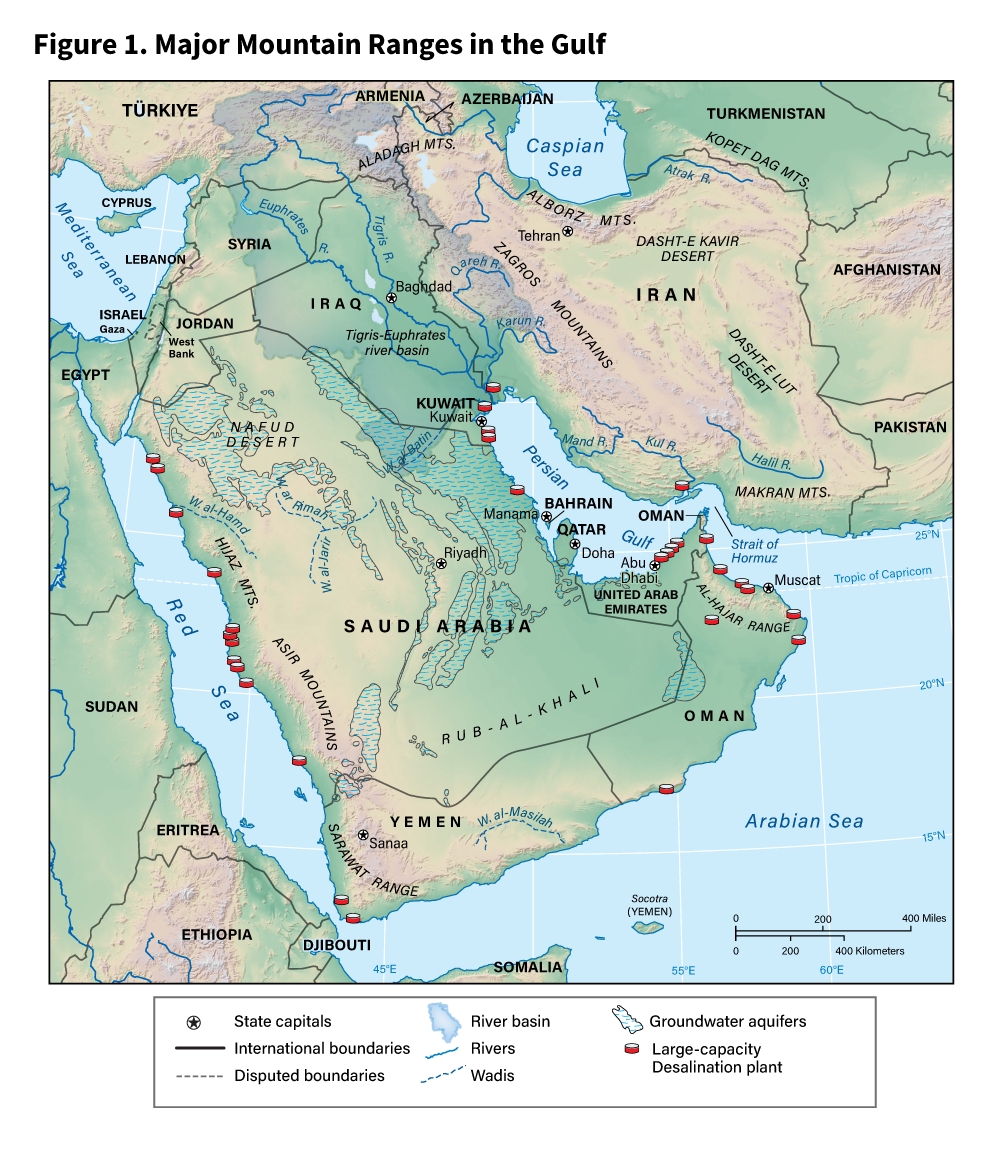
Complex regeneration, then, refers to the coordinated restoration of hydrological systems—from atmospheric to ground and subground levels and between green and blue water—through such interventions.
Crucially, it pairs this restoration with cooperative dialogue, transforming ecological interdependence into a platform for political engagement.
In this model, dialogue is reframed. Instead of adjudicating claims over scarcity, it becomes a mechanism for coordinating action to rebuild shared ecological infrastructure. This shift expands the scope of what dialogue can deliver: Hydrological systems produce domestic dividends, such as water availability, agricultural capacity, and reduced heat stress, as well as cross-border benefits, like stability, reduced displacement, and shared ecological baselines. As such, ecological cooperation becomes a form of confidence building, reinforcing rather than competing with security priorities. Over time, it could evolve into a blueprint for regional engagement and economic cooperation.
Of immediate concern, though, is the escalation over critical infrastructure like desalination plants. Here, too, complex regeneration is now a vital approach. It should be understood as a practical entry point for de-escalatory dialogue even as the war continues or in its immediate aftermath. It addresses a domain of shared exposure that none of the region’s actors can sustainably secure alone. And because it organizes cooperation around rebuilding rather than dividing the resource base, complex regeneration offers a rare positive-sum platform in a regional environment otherwise dominated by deterrence, retaliation, and mutual suspicion. In a Gulf entering deeper climate change–driven volatility and a recurrent risk of conflict, that is not a peripheral diplomatic advantage; it is an increasingly necessary form of strategic adaptation.
Indeed, every Gulf state, regardless of its alignment, depends on water infrastructure that has now been shown to be targetable. This shared vulnerability is symmetrical in a way that few other dimensions of the conflict are. Proposing a negotiated protection framework for water and ecological infrastructure—even a fragile, informal one—does not require political alignment on the causes of the war, the legitimacy of its parties, or the conflict’s eventual resolution. It requires only a shared recognition that the weaponization of water scarcity generates costs that no regional actor can ultimately afford.
The Gulf offers a compelling environment for piloting the complex regeneration paradigm. The region’s hydrological and atmospheric systems already link states: Mountain ranges in Iran, Iraq, and the Arabian Peninsula modulate rainfall across borders; groundwater aquifers extend under national territories; and marine and coastal ecosystems connect via the Gulf and the Arabian Sea. These ecological interdependencies can serve as the basis for new cooperative pathways.
At the same time, wealthier Gulf states have both the financial capacity and the strategic incentive to invest in long-term hydrological security. Sovereign wealth funds, national adaptation plans, and industrial transformation agendas create potential alignment with large-scale ecological infrastructure. Meanwhile, external actors, including the EU, can support the Gulf states on the basis of shared interests and skills in water diplomacy, experimentation with resilience at scale against the background of climate change, and similar ambitions for supply-chain security and industrial decarbonization. These alignments create diplomatic and financial opportunities.
This paper examines how complex regeneration can be operationalized as a mechanism for Gulf cooperation. It draws on the scientific, technical, and diplomatic work conducted during the 2023–2024 Track 1.5 process and synthesizes the project’s climate and hydrological assessments. In proposing a cooperative architecture, the paper identifies the institutional, financial, and sequencing components required to translate the approach into practice. Even as the Gulf enters a period of acute geopolitical turbulence, the purpose of this paper is not to instrumentalize the war but to show how hydrological regeneration can help structure future dialogue, de-escalation, and regional security planning once the current cycle of violence subsides.
In 2013, a United Nations (UN) Water task force defined water security as “the capacity of a population to safeguard sustainable access to adequate quantities of acceptable quality water for sustaining livelihoods, human well-being, and socio-economic development; for ensuring protection against water-borne pollution and water-related disasters; and for preserving ecosystems in a climate of peace and political stability.”7 In the Gulf, every dimension of this definition is being eroded. Water scarcity, climate disruption, ecological collapse, and infrastructural vulnerability now converge in ways that directly shape domestic stability, foreign policy behavior, and regional conflict dynamics.
Structurally, the Gulf is the most water-stressed region in the world (see map 2). Bahrain, Kuwait, and Qatar possess almost no renewable freshwater. Saudi Arabia has no rivers and combines some of the lowest rainfall averages with some of the highest evaporation rates globally. Across the region, the availability of renewable water has collapsed from over 4,000 cubic meters (141,000 cubic feet) per capita in 1950 to under 1,000 cubic meters (35,000 cubic feet) in 2024, placing every Gulf state below international water-scarcity thresholds.8 Iran faces similar pressures, with 70–80 percent of its water consumption devoted to agriculture despite significant dependence on food imports.
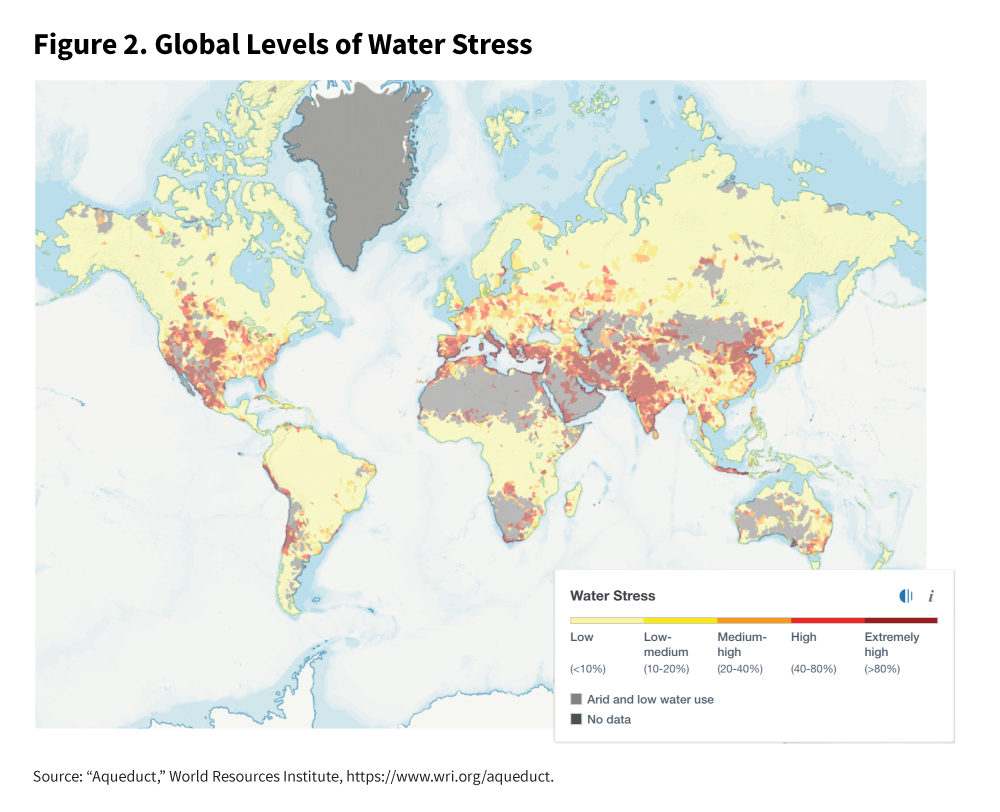
In response to structural scarcity, Gulf, Middle Eastern, and North African states have built two major pillars of water security: externalizing food demand through imports and acquisitions of foreign land; and manufacturing water through desalination and deep groundwater extraction. Over 20,000 square kilometers (7,700 square miles) of land has been acquired since 2000 in producer regions that are vulnerable to climate change, such as Algeria, Egypt, the Horn of Africa, Pakistan, and Sudan.9 As ecological instability accelerates across these regions, externalization becomes less and less viable as a long-term food-security strategy, exposing states to supply disruptions in politically fragile environments.
The second pillar—manufactured water—has enabled the Gulf to sustain high domestic consumption despite a near-zero renewable supply (see figure 1). More than 400 desalination plants produce roughly 7 trillion liters (1.5 trillion gallons) of fresh water annually, complemented by large-scale groundwater extraction and weather modification.10 This technological assemblage underpins urban life, industrial development, and state legitimacy, but it also generates accumulating vulnerabilities.
From a kinetic perspective, these plants are critical infrastructure beneath open skies, making them clear targets in the U.S.-Iran war. From an ecological perspective, desalination produces approximately 70 percent of global brine waste, with around 10–12 billion metric tons discharged each year into the Gulf’s semienclosed waters.11 This discharge accelerates salinity, degrades marine ecosystems, and contributes to harmful algal blooms.12 Fossil groundwater extraction has caused soil salinization, land subsidence, and even measurable shifts in Earth’s gravitational field.13 Rising energy demand compounds these stresses: By current estimates, desalination could account for 15 percent of the Gulf’s energy consumption by 2050, deepening the structural coupling between water, energy, and climate security.14
These pressures are magnified by population growth, industrial diversification, large-scale coastal urbanization, and the rise of water-intensive digital infrastructure.15 Conservative estimates suggest that climate change–related water scarcity could reduce gross domestic product in Arab states by at least 14 percent by 2050.16 On current trajectories—characterized by declining recharge, rising evaporation, and depleted aquifers—technological adaptation alone will not be sufficient to secure the region’s ecological base.
Climate change is amplifying hydrological pressures across the Gulf. Heat waves are expected to increase three- to sixfold, lasting weeks or months.17 Temperatures in some areas are projected to exceed 56° Celsius (133° Fahrenheit)—surpassing human physiological tolerance for outdoor labor and complicating military, industrial, and energy operations.18
The year 2024 underscored a more worrying trajectory. Multiple climate anomalies exceeded model projections, with the southeastern Gulf emerging as a hot spot for abnormal heat patterns not anticipated in earlier forecasting (see map 3).
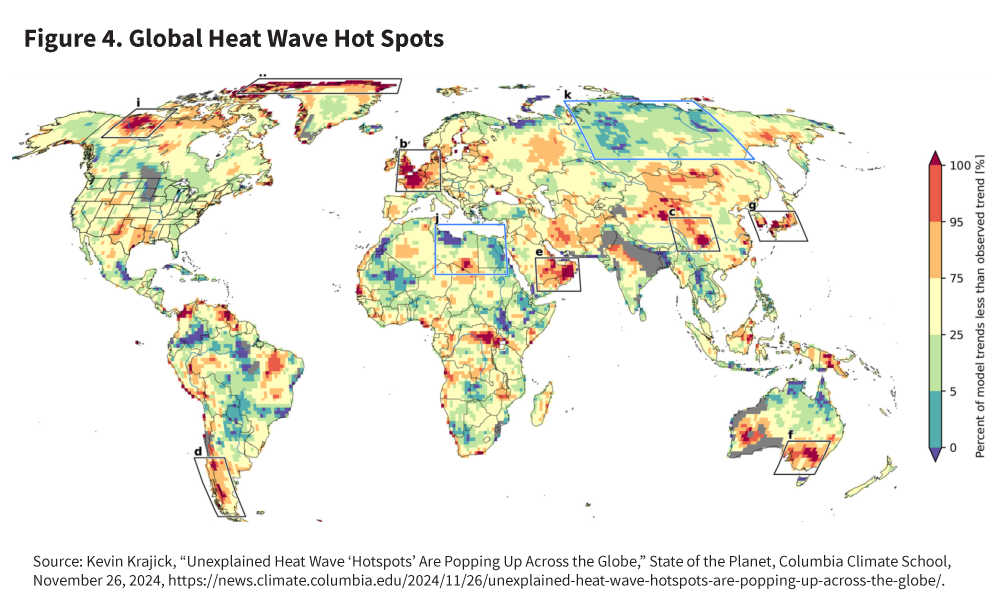
These findings suggest nonlinear dynamics consistent with rapid warming and ecological destabilization. Going forward, the dominant trend will be less about scarcity alone and more about volatility: erratic rainfall, destructive flash floods, prolonged droughts, dust storms, cyclones, and compounding impacts that ripple across food systems, energy infrastructure, labor productivity, and public health. For Gulf governments whose social contracts depend on the provision of services and reliable infrastructure, this volatility has strategic implications.
Across the wider region, water scarcity has already contributed to fragility, displacement, and conflict. In Yemen, long-term depletion of groundwater has aggravated rural grievances and weakened state control, indirectly enabling the rise of the Houthi movement.19 Water continues to be weaponized, and basic access has become a driver of community-level violence.20 In Iraq, declining flows in the Tigris-Euphrates basin have inflamed tensions between Baghdad and the Kurdish region, triggered antigovernment protests, and accelerated internal displacement.
Research anticipates rainfall declines of 15–25 percent this century and potential reductions in river flows of up to 73 percent, with cascading consequences for groundwater levels, marshland ecosystems, agricultural livelihoods, and political stability.21 In Iraq, climate change–induced displacement amounted to over 180,000 people in 2025—compared with some 68,000 in 2022.22
Iran offers another case in which environmental and political instability converge. Recurring water protests, especially in the southwestern province of Khuzestan, reflect intensifying scarcity compounded by mismanagement and industrial extraction.23 Spring groundwater recharge for Iran and Iraq is projected to decline by up to 77 percent by 2100 because of reduced snowfall on the Iranian and Anatolian plateaus.24 Between 2030 and 2050, an estimated 1.3–1.7 million Iranians could be displaced from coastal areas due to sea-level rise and salinization.25 In late 2025, Tehran—a city of 10 million people—faced evacuation warnings because of water shortages.26
These national crises have regional spillovers. Hydrological systems cross borders through rivers, shared aquifers, and atmospheric moisture corridors. Disputes over Iran’s construction of dams on the Karkheh and Karun Rivers have strained relations with Iraq.27 Saudi Arabia and Kuwait navigate tensions over shared aquifers, such as Al-Khobar and Al-Ratqa.28 Control of the Shatt al-Arab River is politically sensitive, reflecting the intersection of water access, territorial control, and national pride.29
As water levels decline regionwide, national responses tend to become unilateral, reducing trust and increasing the likelihood of maladaptive competition rather than cooperative management.
For Gulf states, particularly Saudi Arabia, hydrological collapse in neighboring Iran, Iraq, and Yemen introduces second-order risks: migration pressures, maritime insecurity, food-supply vulnerability, and a heightened probability that regional rivals will use resource stress to justify coercive or escalatory behavior.
Despite clear evidence of accelerating climate change–induced water insecurity, adaptation strategies in the Gulf are predominantly national, technocratic, and fragmented. Disaster risk reduction plans exist in many countries, but their implementation is uneven and climate-water dynamics are rarely framed as strategic security concerns.30 Existing regional platforms, such as the GCC Ministerial Committee, the Arab Ministerial Water Council, and the GCC Unified Water Strategy, have improved technical coordination but are limited by narrow participation, technical silos, and slow execution. Water cooperation is often treated as secondary to hard-security concerns, delaying measures that could serve as confidence-building mechanisms.
More importantly, adaptation efforts are built on a paradigm that seeks to manage the consequences of scarcity rather than reverse its causes. The root problem is conceptual: Water is treated as a diminishing commodity to allocate, rather than a regenerative system governed by hydrological cycling that can be restored. National adaptation strategies are operating at the wrong scale. Hydrology functions at the bioregional level, linking the Gulf through water systems that do not respect political boundaries. In a region disrupted by climate change, this mismatch between the scale of ecological processes and the scale of political intervention is a strategic liability.
Water scarcity in the Gulf is the expression of a broken hydrological cycle. Hydrology is a dynamic, regenerative system that can be restored if the ecological functions that underpin it are rebuilt. Once water is understood in this way as a process—a flow that moves between soils, vegetation, surface bodies, underground reserves, and the atmosphere—it becomes clear that scarcity is reversible. Water can be replenished. Ecological infrastructures can be rebuilt. With them, collective security can be enhanced and strengthened.
In practice, this means restoring the connective tissue between what scientists refer to as blue water (rivers, wadis, and seas), green water (soil moisture, vegetation, wetlands, and biomass), and atmospheric, riverine, and subterranean reserves. A stable hydrological cycle depends on the interplay between these forms. In the Gulf today, like in many other world regions, those interactions are disrupted.31
Complex regeneration responds by restoring the green water that anchors the entire cycle. Green water governs infiltration, evapotranspiration, cloud formation, and rainfall stability. When green-water systems are rebuilt, rainfall tends to become more predictable, shallow aquifers are recharged, soil temperatures moderate, dust storms decline, and local climates stabilize. Successful dryland restoration projects from the Sahel to the Loess Plateau show that even severely degraded landscapes can regenerate rainfall patterns, increase water availability, and improve agricultural productivity within years rather than decades.32 In the Gulf context, the stakes are existential: Without green water, desalination and groundwater extraction will remain the only water sources, leading to more ecological contraction, structural volatility, and kinetic vulnerability; with it, the region regains ecological levers over its own security.
Saudi Arabia, Kuwait, Iraq, and northern Iran are linked by winter moisture rivers that determine the risk of flash floods and the recharge of shallow aquifers. Southern Iran, Yemen, Oman, Saudi Arabia, and the UAE are bound by monsoon-connected moisture systems that influence coastal springs, wadi agriculture, and cyclone vulnerability. Iran and Iraq are tied through the Zagros-fed watersheds of Khuzestan, while the Umm Er Radhuma–Dammam aquifer quietly underpins municipal and industrial water security across Saudi Arabia, Qatar, Bahrain, and Kuwait. In such a system, no state can secure water alone, even if it possesses the financial or technological means to delay scarcity within its borders. Climate change is making this increasingly obvious.
This is why complex regeneration is inherently existential—a reality whose strategic dimension has become painfully clear in the 2026 U.S.-Iran war. This approach requires immediate de-escalation over specific redlines and opens the door to sequenced coordination on shared interests that promote confidence-building measures and dialogue. With a well-designed process and solid outcomes in the first phases, the longer-term hope is to lay the groundwork for cooperative arrangements at a regional scale.
For this approach to function, it is essential to identify where atmospheric, surface, and underground water systems intersect; where mountainous trigger points can capture moisture and convert it into precipitation; where valleys, wadis, and coastal zones can store and recycle that water; and how these processes reinforce one another across borders. The Gulf’s strategic trigger zones are not only biophysical leverage points but also geopolitical building blocks. They define where ecological intervention generates the greatest regional benefit, and they map the interdependencies that a new security architecture must reflect.
Crucially, complex regeneration does not require abandoning industrial systems; it resituates them. Desalination remains useful as a transition tool, but its burden decreases as aquifers are recharged and climatic extremes moderate. Managed aquifer recharge (MAR) becomes more effective when infiltration and soil moisture increase.33 Solar-powered MAR systems, which have already been piloted in dryland contexts, become more viable as dependence on desalination declines.34 Hydrological regeneration therefore works with existing adaptation systems but changes their long-term role from primary water source to buffer and backstop.
Politically, the novelty lies in how cooperation is built. Conventional water diplomacy and mediation revolve around resource allocation—how to divide access among stakeholders in times of scarcity. In a world disrupted by climate change, this logic reaches diminishing returns: Negotiating access to dwindling rivers or collapsing aquifers generates zero-sum outcomes and hardened positions. Complex regeneration inverts the sequence. It begins not by dividing scarcity but by expanding supply through ecological rebooting, making cooperation a positive-sum enterprise. Technical coordination on the basis of foundational resources becomes a confidence-building measure; ecological data sharing becomes an instrument of transparency; and joint regeneration becomes a form of preventive diplomacy grounded in shared interests rather than contested resources.
In this sense, complex regeneration acts as a security instrument. By working to rebuild water availability, it reduces dependence on food imports, lowers desalination-energy coupling, stabilizes agricultural livelihoods, and dampens the drivers of internal unrest, displacement, and interstate tension. By organizing cross-border coordination of atmospheric and aquifer systems, it builds cooperative muscle memory in a region where geopolitical relations are regularly on the brink of tacit or open warfare. And by linking ecological work to hydrological outcomes, it turns the process of regeneration into both a diplomatic platform and a mechanism of strategic stabilization.
The Gulf region is one of the few places on Earth where the logics of climate, ecology, and geopolitics converge so sharply. As water insecurity magnifies hard-security risks—from kinetic warfare, maritime choke points, and energy corridors to displacement routes and regional alliances—the need for a different category of dialogue and cooperation is now unavoidable. Complex regeneration offers that category. It aligns biophysical reality with geopolitical necessity and, in doing so, points to a new approach to regional security: one where hydrological stabilization is not an environmental add-on but a foundation for peace, economic resilience, and a cooperative political architecture.
Understanding how to reverse the Gulf’s water trajectory requires grasping three linked hydrological systems: aquifers, surface bodies, and atmospheric moisture corridors. Each is currently destabilizing; each is also a potential leverage point for repairing the water cycle.
Aquifers are the region’s hidden backbone. From the Umm Er Radhuma–Dammam system to the Eastern Arabian and Wajid aquifers that connect Saudi Arabia, the UAE, and Yemen, groundwater has long supported cities, energy corridors, and agriculture (see table 1). Yet, many of these reserves are fossil aquifers with negligible recharge. Extraction without replacement therefore liquidates natural capital and replaces geological time with industrial speed. When the recharge of shallow aquifers collapses—as it has across parts of Iraq’s Zagros-fed basins or Yemen’s uplands—agriculture fails, salinity increases, and water scarcity cascades into social and economic fragility. Sandstorms become the visible symptom of much deeper dehydration.
Surface waters are equally stressed. The Tigris-Euphrates system, which sustains tens of millions of people across Turkey, Syria, Iraq, and Iran, is experiencing declining flows linked to upstream infrastructure, reduced snowfall, and higher evaporation (see table 2). Flash floods in Saudi Arabia, Oman, and the UAE illustrate a parallel problem: Rainfall increasingly arrives as violent runoff rather than slow infiltration, overwhelming drainage while doing little to replenish water tables. Wetlands such as Iraq’s Mesopotamian Marshes, which once moderated weather, supported livelihoods, and recycled moisture, deteriorate under combined climatic and political strain, removing natural buffers that previously bolstered regional stability.
The third system is less visible but strategically decisive: atmospheric moisture. It is the system that has never featured in any water-related dialogue in the region—or anywhere else. The Gulf is connected by winter moisture rivers and monsoon-linked moisture systems that govern rainfall timing, wadi recharge, cyclone patterns, shallow aquifer replenishment, and even dust storm dynamics (see figure 2).
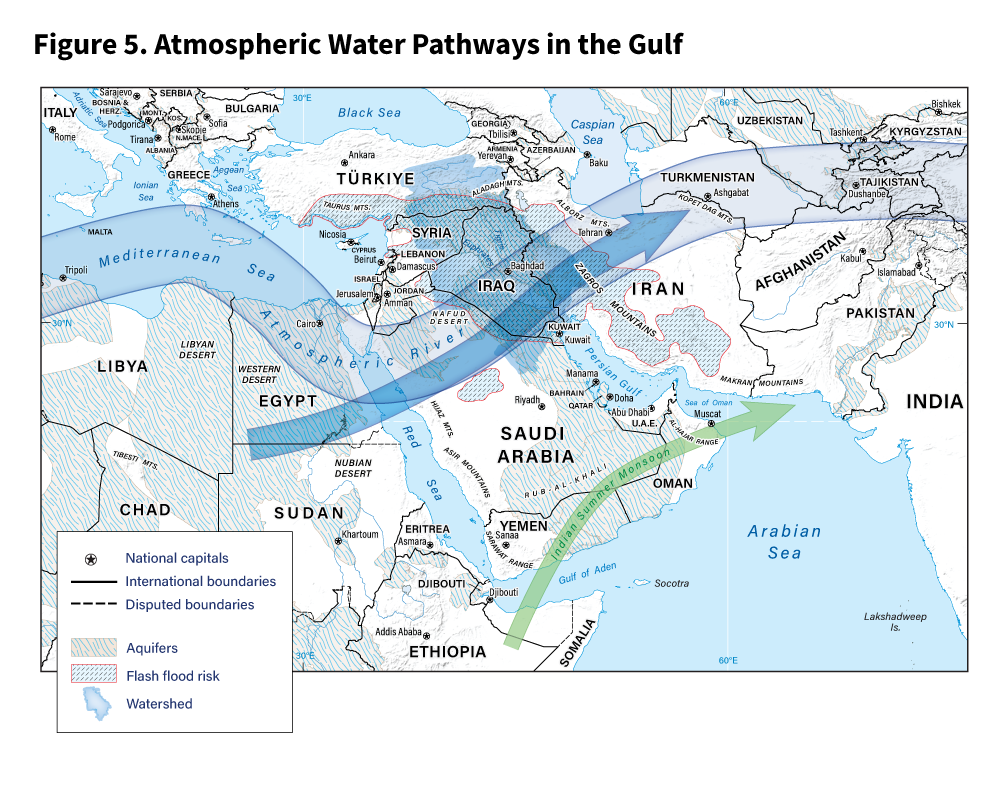
Climate change is making these systems unstable. Atmospheric rivers deliver harsher floods followed by droughts; monsoon shifts disrupt springs and wadis; and cyclones produce destructive rainfall that coastal systems are unprepared to absorb. Stabilizing them depends on two fundamental sets of action: accelerating climate-change mitigation, and regenerating the ecological infrastructure that is responsible for mediating and regulating water between its gaseous and liquid forms. The Gulf’s hydrological future is, and always has been, shaped as much in the sky as in the soil. Working with atmospheric moisture is essential to rebuild water security.
Complex regeneration works by reconnecting these three systems through sequenced ecological interventions that rebuild green water, enhance infiltration, stimulate rainfall, and recharge aquifers. The strategy begins in the places where climate, geology, and atmosphere intersect most powerfully: mountainous trigger zones. The Zagros, Sarawat, Asir–Hijaz, and Hajar mountain ranges all intercept moist air masses, creating orographic uplift and precipitation. Historically, these ranges captured atmospheric moisture, fed rivers and wadis, and supported the vegetation that recycled humidity across the region. As vegetation has been lost and soils have degraded, this mechanism has weakened.
The objective is to generate diffuse hydrological benefits across the region by leveraging existing atmospheric, surface, and subsurface water connectivity as well as dominant wind-transport patterns. The Gulf region spans over 7 million square kilometers (2.7 million square miles).
Over the next twenty years, proposed ecoindustrial regeneration aims to rehabilitate almost 2.2 million square kilometers (800,000 square miles).
By restoring vegetation, soil structure, and infiltration capacity in these trigger zones, regeneration interventions can increase orographic precipitation and moisture recycling. The process operates through known ecohydrological mechanisms (see box).
To ensure scientific transparency, the process of complex regeneration relies on several explicit assumptions drawn from ecohydrology, land-atmosphere science, and emerging hydrological cycling theory. These represent the current frontier of research on the role of green water in climate-change adaptation. The assumptions are ordered below from most to least established in the scientific literature.
Orographic precipitation potential is currently suppressed and can be restored. Mountain ranges in the Gulf have significant unrealized rainfall potential because of vegetation loss, surface degradation, and reduced land-atmosphere coupling. In southwestern Saudi Arabia, annual rainfall jumps from under 100 millimeters (3.9 inches) on coastal plans to 300–500 millimeters (11.8–19.7 inches) in the Asir highlights.1 The Zagros range receives 400–800 millimeters (15.7–31.5 inches) on its western slopes,2 while rainfall in the Iranian interior drops below 200 millimeters (7.9 inches).3 Rebuilding vegetation, soil stability, and surface roughness on degraded slopes can make uplift more efficient and increase precipitation capture on these existing gradients.4
Vegetation restoration shifts the surface energy balance from heat to moisture. Bare desert surfaces convert most absorbed solar energy into sensible heat, with Bowen ratios (a measure used to calculate heat loss) reaching 5–10 and midday surface temperatures exceeding 50°C (122°F). Vegetated surfaces redirect that energy into evapotranspiration, with Bowen ratios dropping to 0.5–1 and surface temperatures falling by 10–15°C (18–27°F) relative to adjacent bare land.5 This cools the boundary layer and lowers the altitude at which clouds form. Saudi Hima rangeland systems have documented measurable improvements in soil moisture retention, surface cooling, and infiltration after vegetation recovery.6
Large-scale vegetation restoration increases evapotranspiration and the production of cloud condensation nuclei enough to influence the regional availability of moisture.7 Restored vegetation releases biogenic volatile organic compounds that seed cloud formation. Current moisture recycling across the Arabian Peninsula sits at 5–10 percent. Restoration at scale could raise this to 15–25 percent, calibrated against semiarid mountain analogues and well below the 60–80 percent recycling observed in the Amazon.8
Continental moisture recycling can be amplified through distributed restoration, strengthening short-range moisture recycling and increasing downwind rainfall.9 On the Chinese Loess Plateau, twenty years of revegetation across 35,000 square kilometers (13,500 square miles) reduced annual storm flow by 20–50 percent while sustaining base flow.10 In Niger’s Sahel, farmer-managed regreening across 50,000 square kilometers (19,300 square miles) raised water tables by several meters.11
Atmospheric river pathways can be modulated by land-surface changes.12 Atmospheric rivers are the dominant moisture-delivery mechanism for Gulf mountain systems: In the Zagros, a small number of events each winter account for most annual precipitation.13 A 2019 atmospheric river stretching roughly 9,000 kilometers (5,600 miles) from the Atlantic across North Africa produced record rainfall when orographic forcing lifted moisture over the Zagros.14 This mechanism is well established in atmospheric physics but has not been validated at operational scales in the Gulf; pilot monitoring at restored sites is needed to quantify the enhancement.15
Finally, a biotic pump mechanism could operate in Gulf coastal-mountain interfaces, where large vegetated systems create persistent low-pressure zones that draw moist air inland.16 This remains an emerging hypothesis. Projections that include it are treated as upper-bound estimates.
1 Hosny Hasanean and Mansour Almazroui, “Rainfall: Features and Variations over Saudi Arabia, A Review,” Climate 3, no. 3 (2015): 578–626, https://doi.org/10.3390/cli3030578.
2 Bohloul Alijani, “Effect of the Zagros Mountains on the Spatial Distribution of Precipitation,” Journal of Mountain Science 5, no. 3 (2008): 218–231, https://doi.org/10.1007/s11629-008-0126-8.
3 Tayeb Raziei, Isabella Bordi, and Luis Santos Pereira, “A Precipitation-Based Regionalization for Western Iran and Regional Drought Variability,” Hydrology and Earth System Sciences 12, no. 6 (2008): 1309–1321, https://doi.org/10.5194/hess-12-1309-2008.
4 Gerard H. Roe, “Orographic Precipitation,” Annual Review of Earth and Planetary Sciences 33 (2005): 645–671, https://doi.org/10.1146/annurev.earth.33.092203.122541.
5 Gordon B. Bonan, “Forests and Climate Change: Forcings, Feedbacks, and the Climate Benefits of Forests,” Science 320, no. 5882 (2008): 1444–1449, https://www.science.org/doi/10.1126/science.1155121; and Sonia I. Seneviratne et al., “Investigating Soil Moisture–Climate Interactions in a Changing Climate: A Review,” Earth-Science Reviews 99, nos. 3–4 (2010): 125–161, https://doi.org/10.1016/j.earscirev.2010.02.004.
6 For the general mechanism of vegetation-driven surface cooling and moisture retention in drylands, see Bonan, “Forests and Climate Change.” For an economic and ecological valuation of Hima rangeland restoration in the Arabian Peninsula, see Vanja Westerberg and Moe Myint, “An Economic Valuation of a Large-Scale Rangeland Restoration Project Through the Hima System in Jordan,” The Economics of Land Degradation, June 2015, https://portals.iucn.org/library/sites/library/files/documents/2015-009.pdf. For comparable restoration outcomes in Jordanian drylands documenting improved infiltration, carbon sequestration, and sediment stabilisation following Hima-based management, see Hala Kilani et al., “Al-Hima: A Traditional Conservation Approach in the Arabian Peninsula,” International Union for Conservation of Nature Regional Office for West Asia, 2020, https://policycommons.net/artifacts/1375888/al-hima/1990151/.
7 Patrick W. Keys, Lan Wang-Erlandsson, and Line J. Gordon, “Revealing Invisible Water: Moisture Recycling as an Ecosystem Service,” PLOS One, March 21, 2016, https://doi.org/10.1371/journal.pone.0151993.
8 Elfatih A. B. Eltahir and Rafael L. Bras, “Precipitation Recycling in the Amazon Basin,” Quarterly Journal of the Royal Meteorological Society 120, no. 518 (1994): 861–880, https://doi.org/10.1002/qj.49712051806; and Rudi J. van der Ent et al., “Origin and Fate of Atmospheric Moisture over Continents,” Water Resources Research 46, no. 9 (2010): W09525, https://doi.org/10.1029/2010WR009127.
9 Dominick V. Spracklen, Steve R. Arnold, and Christopher M. Taylor, “Observations of Increased Tropical Rainfall Preceded by Air Passage over Forests,” Nature 489, no. 7415 (2012): 282–285, https://doi.org/10.1038/nature11390; and Andrew J. Pitman et al., “Uncertainties in Climate Responses to Past Land Cover Change: First Results from the LUCID Intercomparison Study,” Geophysical Research Letters 36, no. 14 (2009): L14814, https://doi.org/10.1029/2009GL039076.
10 Liding Chen et al., “Soil and Water Conservation on the Loess Plateau in China: Review and Perspective,” Progress in Physical Geography 31, no. 4 (2007): 389–403, https://doi.org/10.1177/0309133307081290.
11 Reij et al., “Dryland Restoration Successes.”
12 David Ellison et al., “Trees, Forests and Water: Cool Insights for a Hot World,” Global Environmental Change 43 (2017): 51–61, https://www.sciencedirect.com/science/article/pii/S0959378017300134.
13 Christine A. Shields et al., “Atmospheric River Tracking Method Intercomparison Project (ARTMIP): Project Goals and Experimental Design,” Geoscientific Model Development 11, no. 6 (2018): 2455–2474, https://doi.org/10.5194/gmd-11-2455-2018; and Bin Guan and Duane E. Waliser, “Detection of Atmospheric Rivers: Evaluation and Application of an Algorithm for Global Studies,” Journal of Geophysical Research: Atmospheres 120, no. 24 (2015): 12514–12535, https://doi.org/10.1002/2015JD024257.
14 Elias Massoud et al., “Atmospheric Rivers and Precipitation in the Middle East and North Africa (MENA),” Water 12, no. 10 (2020): 2863, https://doi.org/10.3390/w12102863. The March 2019 event produced catastrophic flooding across western Iran, affecting twenty-two out of thirty-one provinces and 11.5 million people: Sonam Futi Sherpa and Manoochehr Shirzaei, “Country-wide Flood Exposure Analysis Using Sentinel-1 Synthetic Aperture Radar Data: Case Study of 2019 Iran Flood,” Journal of Flood Risk Management 15, no. 1 (2022): e12770, https://doi.org/10.1111/jfr3.12770.
15 F. Martin Ralph et al., “A Scale to Characterize the Strength and Impacts of Atmospheric Rivers,” Bulletin of the American Meteorological Society 100, no. 2 (2019): 269–289, https://doi.org/10.1175/BAMS-D-18-0023.1; and David A. Lavers et al., “Future Changes in Atmospheric Rivers and Their Implications for Winter Flooding in Britain,” Environmental Research Letters 8, no. 3 (2013): 034010, https://iopscience.iop.org/article/10.1088/1748-9326/8/3/034010.
16 Anastassia M. Makarieva and Victor G. Gorshkov, “Biotic Pump of Atmospheric Moisture as Driver of the Hydrological Cycle on Land,” Hydrology and Earth System Sciences 11, no. 2 (2007): 1013–1033, https://hess.copernicus.org/articles/11/1013/2007/.
Once rainfall capture and infiltration are reestablished in upland zones, the strategy extends downslope to valleys, floodplains, and coastal systems. Wadis can be redesigned as infiltration corridors: Field measurements in Saudi wadis show that vegetated channels lose substantial flow to infiltration while degraded channels absorb far less.35 Marshes and wetlands moderate floods and release moisture, and mangroves protect coastal aquifers from saline intrusion. Without upland capture, valley interventions lack supply; without valley retention, upland rainfall escapes to the sea; and without coastal buffers, saline intrusion undermines water security (see figure 3).
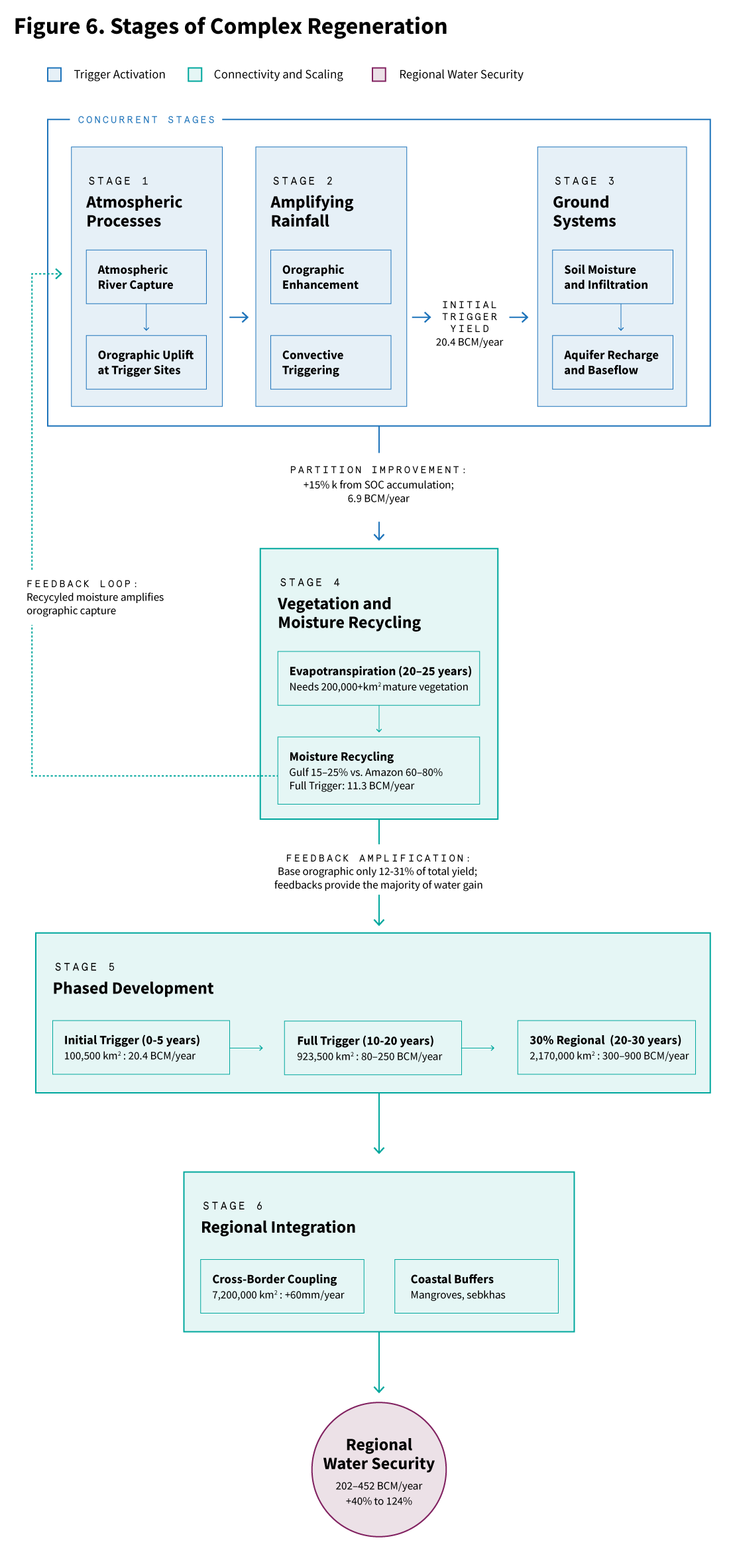
The aim is not to re-create historical ecosystems but to rebuild enough hydrological function to stabilize the regional water balance. In short, trigger points are the start of a much wider process of ecological rebooting at the regional level. In practical terms, regeneration starts with subregional clusters in trigger points, aiming to produce diffuse hydrological and ecological benefits (see table 3). After three to five years, regeneration efforts can escalate toward a much more coordinated and integrated regional effort to amplify hydrological feedback loops and generate returns for the real economy. The whole process aims to make rainfall more predictable, reduce destructive runoff, increase the recharge of shallow aquifers, moderate temperature extremes, strengthen agricultural and economic resilience, reduce energy-intensive technological dependencies, and protect infrastructure.
Importantly, these gains accumulate. The longer ecological processes operate, the more coordinated they become, the more they build toward regional integration, the more water is stored in soils, biomass, and aquifers, and the more stable atmospheric dynamics become. And from there, climate, water, food, energy, and economic security dividends multiply. Crucially, the trigger points are the first stage of a large-scale ecological rebooting that eventually leads to a self-sustaining regional hydrological system. Complex regeneration aims to re-create the ecological and water infrastructures that support whole-of-society security and foster the political and economic incentives to maintain regenerative processes over time.
The Gulf’s atmospheric, surface, and subsurface systems cross borders, meaning no single country can restore the cycle on a national scale. Upland restoration in the Zagros affects rainfall and river flows in southern Iraq; regeneration in the Sarawat and Asir–Hijaz mountain ranges influences moisture recycling across Yemen and Saudi Arabia; and stabilizing the Hajar system affects coastal aquifers and humidity regimes in Oman and the UAE. These hydrological interdependencies provide the basis for new cooperative arrangements: They specify where joint intervention can yield shared benefits, and they clarify the spatial mechanics of positive-sum security.
What differentiates complex regeneration from conventional adaptation is therefore not only what it restores but also how it scales. It treats ecological function as a form of critical infrastructure, and hydrological repair as a foundation for water, food, and energy security. Complex regeneration offers an alternative to the extractive approach of desalination and groundwater mining by rebuilding the natural systems that historically supplied water to Gulf societies. And because it operates through cross-border biophysical processes, regeneration becomes a rare domain in which technical coordination produces political dividends: shared monitoring, impact metrics, sequencing, and benefits.
These technical dynamics are not an environmental luxury; they are a strategic asset. They allow Gulf governments to diversify their water portfolios away from dependence on desalination, stabilize rather than abandon agricultural zones, reduce dust and heat stress that burden power grids and labor markets, and build credible buffers against climate change–induced migration and unrest in neighboring states. Most importantly, these dynamics open a pathway to regional cooperation that aligns with ecological reality, rather than fighting against it.
Complex regeneration not only offers a way to rebuild the Gulf’s water stability but also creates a rarely recognized opportunity for diplomacy. Because the region’s aquifers, rivers, and atmospheric moisture systems are transboundary, hydrological restoration cannot be achieved through national action alone. In fact, uncoordinated national initiatives can be counterproductive. Water security must be co-produced. This ecological interdependence creates the conditions for a new category of mediation and cooperation that is neither extractive nor zero sum: regional hydrological stabilization as a shared security project. Under this approach, the diplomatic calculus changes in three ways.
First, technical cooperation becomes politically meaningful. To regenerate hydrological function, states must create a culture for collecting data on rainfall, groundwater levels, soil moisture, vegetation cover, and atmospheric moisture flows. If these data are considered sensitive, an independent body or trusted third party can collect and process them until trust has been established for transparent collective exchange. Over time, this exchange reveals mutual benefits and system dynamics that are otherwise obscured by national silos. In the Gulf, this opens channels of communication between institutions that rarely interact: water ministries, meteorological services, agricultural agencies, environmental authorities, and planning bodies. These technical relationships can endure even when political ones are strained.
Second, sequencing creates trust with the ambition to tackle harder issues. Regeneration requires action in phases—upland capture, valley infiltration, wetland buffering, and aquifer recharge. Impacts unfold gradually, with measurable hydrological and agricultural gains emerging within three to five years. This allows cooperation to begin with limited technical coordination at the local or subregional level, building trust through concrete outcomes before advancing toward more sensitive topics, such as transboundary governance or joint financing. Unlike conventional negotiations, which often begin with politically charged issues like dams, pumping rights, or water shares, regeneration starts with interventions that produce tangible benefits with minimal risk to sovereignty.
Third, a new type of cooperation architecture becomes imaginable. Because hydrological systems define the geography of cooperation, regional arrangements can be organized around shared ecological units rather than geopolitical blocs. The Zagros, Asir–Hijaz, Sarawat, and Hajar ranges, the Mesopotamian Marshes, and the Gulf’s coastal sebkhas (salt flats) and mangrove corridors are not political territories but biophysical leverage points. They draw the contours of an emerging geopolity: bioregions. Coordinating interventions across these units allows states to co-manage the atmospheric and subsurface processes that shape their water futures. Over time, these units form the skeleton of a new cooperative security architecture rooted in ecological function rather than military balance or ideological alignment.
Crucially, this approach does not bypass politics; it reconfigures the starting point. It recognizes that ecological stabilization is both technically demanding and politically sensitive, but it treats ecological work as the domain through which political cooperation can be gradually constructed. In this sense, regeneration becomes an instrument of political construction: Data collection, monitoring, joint pilot projects, and scientific advisory groups serve as de-escalation mechanisms in a region where distrust is chronic and security dilemmas are entrenched.
The 2023–2024 Track 1.5 dialogue convened by the ACP demonstrated how this can work in practice. Technical experts and policy practitioners from across the Gulf and Iran met in iterative, third-party-supported settings to explore the region’s changing climate-security landscape, geostrategic condition, and security triggers while examining the hydrological, ecological, and infrastructural factors that shape regional instability. As participants examined the Gulf’s ecological vulnerabilities and security trajectories, the conversation expanded from water management to ecological diplomacy, from environmental stress to the politics of security interdependence, and from ecological teleconnections to visions of regenerated resource futures.
What emerged from that process was not a consensus on how to divide resources but a recognition that shared regeneration could build the foundations of future cooperation. Participants began to envision hydrological stabilization as a confidence-building pathway that could precede and enable discussions of more sensitive issues: maritime security, the proliferation of nonstate actors, the circulation of small arms, or humanitarian access.
In a region where hard-security issues are difficult to address directly, regeneration provided a pragmatic entry point that did not trigger threat perceptions or sovereignty fears.
This is especially true because complex regeneration relies on nature-compatible methodologies as opposed to technological interventions, which tend to introduce so-called black-box issues in geopolitically charged environments.
In this way, complex regeneration introduces quiet but consequential innovations to the practice of mediation and dialogue: It turns ecological intervention into diplomatic architecture. It uses technical work to open political space. It creates shared stakes without forcing premature political alignment. And it proposes that in a world destabilized by climate change, geopolitical engagement may require states not only to negotiate their interests but also to rebuild the ecological systems that make peace remotely possible again.
The Gulf is not the only region where this logic applies, but it is one of the most urgent. Hydrological stabilization there will not resolve all geopolitical rivalries, nor will it end regional wars. But it can reduce the volatility that fuels them, create platforms for cooperation where none currently exist, and build institutional muscle memory for collective problem solving in an era when unilateral adaptation is no longer viable or effective. For dialogue and mediation practitioners, it suggests a new repertoire. For policymakers, it offers a path toward shared resilience. And for regional actors, it reframes climate change not as a threat multiplier to be endured but as a strategic domain in which stability can be actively produced.
If complex regeneration provides the technical basis for hydrological stabilization, the question becomes how to translate this into actual cooperation. The Gulf contains some of the world’s densest geopolitical rivalries: war, blockades, proxy theaters, energy competition, maritime choke points, and unresolved border disputes. It is also a region where political alignments shift rapidly and where security frameworks are predominantly military, bilateral, or externally anchored. Any viable approach must therefore recognize two constraints: sovereignty sensitivities and institutional fragmentation. Regeneration offers a way to work within these constraints rather than against them.
Climate change–driven water insecurity is one of the few issues in the Gulf that creates mutual exposure regardless of political alignment. Saudi Arabia and the UAE face desalination-energy coupling risks; Bahrain and Qatar depend on the same fossil aquifers; Iran and Iraq share hydrological collapse in the Zagros; Yemen’s uplands influence precipitation and dust dynamics across southwestern Saudi Arabia; and Oman’s coastal zones shape cyclone resilience for the Gulf’s entire eastern flank. These shared vulnerabilities do not automatically translate into cooperation, but they create overlapping interests that can be made explicit through diplomatic design.
Regeneration reshapes the diplomatic logic by activating positive interdependencies. When upstream or upwind states restore hydrological function, downstream and downwind states benefit. In contrast to river-basin negotiations, which often begin with contested allocations, regeneration deals in ecological multipliers, making cooperation more attractive than isolation. This logic does not eliminate geopolitical competition, but it changes its current zero-sum trajectory. Under this approach, which starts with ecological clusters whose benefits extend beyond direct areas of regeneration, ecological interdependencies map out the road to regional cooperation at a more coordinated or even integrated level. Once water is regenerated, the possibilities for collective food, energy, and technological security compound.
Given the region’s political volatility, cooperation cannot begin with heavy institutional structures or binding treaties. It requires a sequenced approach that builds trust through technical success before advancing toward formal governance. A necessary condition for the technical scale-up, though, is a political and security commitment from national stakeholders in the region to signal prioritization.
The sequencing implied by complex regeneration consists of three stages. The first focuses on data, diagnostics, and shared hydrological understanding. This stage relies on scientific institutions, universities, meteorological services, and groundwater authorities. Because the information exchanged is ecological rather than strategic, it avoids triggering the threat perceptions associated with military or intelligence sharing. In the Track 1.5 dialogue, such exchanges functioned as confidence-building measures themselves, enabling participants from rival states to discuss climate, water, and security linkages without the political escalation associated with hard-security topics.
The second stage centers on pilot interventions in upland trigger zones, wadis, wetlands, or agricultural valleys. These interventions are limited in spatial scope, visible in impact, and politically low risk. Their purpose is not to transform the entire region at once but to demonstrate feasibility, generate hydrological gains, and normalize cooperation among technical bodies across borders. In adversarial regions, this stage can occur in parallel silos: Each subregional cluster independently pilots but shares scientific methods and monitoring frameworks to create alignment without requiring formal cooperation.
The third stage involves scaling and institutionalization. Once pilot successes are acknowledged, coordination expands to shared monitoring, joint scientific advisory mechanisms, or regional working groups on specific hydrological units. These mechanisms are still framed in technical terms, but they produce a substrate for longer-term governance. In regions such as the Gulf, institutional depth often forms first through technical committees before reaching the level of political bodies. Regeneration fits this pathway precisely.
Complex regeneration in geopolitically fragmented environments both requires and lends itself to staged implementation. In the Gulf, operationalizing regeneration through high-leverage trigger points first, and only subsequently through integrated coordination, provides a route from localized ecological interventions to durable regional architecture.
These interventions would proceed in three phases:
Rather than begin with politically bounded institutions, this approach organizes cooperation around ecological units. Regeneration architecture is thus anchored in hydrological interdependence instead of formal alignments. In practice, the Gulf’s hydrology naturally defines a set of cooperative clusters:
These clusters are not political blocs. They are regenerative cooperation units that reflect underlying hydrological realities. Their activation generates both domestic and collective benefits while preserving diplomatic flexibility: Cooperation can advance where ecological interdependence is strongest, rather than where political alignment is easiest.
As regeneration effects begin to extend beyond initial trigger points, the logic of action shifts. Restored ecological functions reestablish interdependencies across clusters, creating material incentives for coordination on a wider regional scale. At this stage, complex regeneration requires a regional mechanism that can strengthen and sustain ecological recovery across the peninsula.
In its most minimalist form, such a mechanism could be limited to technical coordination—harmonizing monitoring, sequencing interventions, and managing shared data. The mechanism should initially be independent, with a view to coordinating engagement in a geopolitically sensitive manner. In a context of accelerating climate disruption, war, economic exposure, and security volatility, however, the Gulf has a strategic incentive to aim higher. Regeneration opens the possibility of co-designing economic approaches across agriculture, energy, and technology in ways that align economic planning with ecological stabilization. Over time, this enables a closer fit between ecological and economic architectures—to support resilient growth rather than compound vulnerabilities.
The difference between a minimalist coordination platform and a more ambitious cooperative architecture hinges on trust and demonstrated benefit. Crucially, both are created by the regeneration process itself. As hydrological stability improves and co-benefits materialize, the political conditions for deeper cooperation are no longer assumed; they are produced. In this sense, complex regeneration is not only an ecological intervention but also a mechanism through which regional cooperation can progressively take shape under uncertain conditions.
In its barest technical functions, an independent coordination mechanism for collective benefits could work on:
The mechanism would function as a dynamic, multilayered system. A political steering committee of national representatives would ensure strategic alignment and sponsorship. Technical and academic working groups would provide research, modeling, and monitoring support, including through hydrological data collection and ecological mapping. Ecoindustrial hubs would design, implement, and optimize regeneration projects, bridging engineering, ecological science, and local knowledge. Interregional learning platforms would enable knowledge transfer, innovation, and collaboration with external partners, such as the EU, UN agencies, and climate research institutes.
By linking political, economic, and technical layers, this cooperation mechanism would transform complex regeneration into a tangible security project. It would create both immediate confidence-building benefits and long-term incentives: a safer, more resilient, and ecologically secure Gulf, with water, energy, and food security distributed as a shared regional asset. Over time, these processes could evolve into a regional economic project akin to the EU’s postwar integration—pooling ecological, industrial, and financial resources to prevent conflict, foster prosperity, and secure the Gulf’s climate change–adaptive future.
A Gulf-wide complex regeneration process would require a blended finance architecture that mobilizes public, private, and carbon-market capital. While detailed costing would depend on feasibility studies, a preliminary analysis estimates a total investment of just under $70 billion over the thirty years of the three phases (see table 4). Although this figure appears substantial, it is modest compared with existing regional climate-related megaprojects: Saudi Arabia’s Vision 2030 developments alone exceed $1.3 trillion, including nature-based initiatives that cannot succeed without the regional hydrological plan proposed here.36
Phase 1—the initial trigger-site interventions in the first five years—must be financed primarily by public-sector actors in the Gulf, complemented where politically appropriate by external guarantors, such as the EU. Public funding at this phase is indispensable for three reasons:
This early public commitment would also serve as a critical confidence-building measure—an essential ingredient for collective action in a region where trust, coordination, and institutional continuity have historically been fragile. Not all countries would be able to contribute financially at the outset. Yemen, for example, faces an active conflict, fragmented governance, and severe fiscal constraints. For such states, international financial institutions, such as the World Bank and the International Monetary Fund, would likely need to participate in the regional mechanism to provide fiscal guarantees, concessional financing, or stabilization support tailored to fragile contexts.
In parallel, local and international nongovernmental organizations, as well as field-delivery partners with experience in conflict-sensitive programming, must be integrated into the design and implementation of regeneration interventions. Their involvement would help ensure that restoration efforts are grounded in local realities, avoid exacerbating existing tensions, and actively contribute to peacebuilding. Bringing these actors into the regional mechanism would strengthen ownership, sustainability, and the capacity to align ecological regeneration with conflict-resolution and community-stabilization processes.
Once regenerative processes are fully activated, carbon finance becomes a major revenue stream, turning ecological recovery into a self-sustaining financial model (see table 5).
Even at a mid-range carbon price of $15 per metric ton, the region would recover the costs of complex regeneration within less than four years. Higher price scenarios would generate substantial fiscal surpluses, transforming regeneration into a revenue-positive strategic asset.
Carbon finance has three structural advantages:
If adapted to securitized environments, tailored carbon-finance products could prevent budgetary asymmetries from undermining collective commitment. They would also establish a methodological template for combining climate and security finance, which could be exported to other hot spots, such as the Horn of Africa, the Mediterranean, the Sahel, or South Asia.
A pooled regional fund should be established to aggregate contributions, signal commitment, and collectivize risk—a central requirement for trust building in the early phases. Complementary investment from development partners could accelerate deployment and reinforce geopolitical confidence in the initiative.
In sum, while a $70 billion regeneration effort may seem ambitious, it is strategically modest relative to the scale of climate threats and the magnitude of regional capital already mobilized for transformation. With appropriate financial structuring, complex regeneration can shift from a public expenditure challenge to a self-funding regional security platform, generating long-term ecological, economic, and geopolitical dividends.
Investing in hydrological function reduces medium-term fiscal and security liabilities associated with desalination dependence, agricultural collapse, dust storms, energy-water coupling, and displacement. It also unlocks new economic sectors: regenerative agriculture, carbon sequestration, ecosystem services, and climate change–resilient infrastructure. In geopolitical terms, it allows Gulf states to future-proof their energy diversification and technological development plans—an essential consideration as data centers, hydrogen, tourism, and advanced manufacturing become more water intensive.
Over time, the cooperative architecture created through regeneration can evolve into a regional security framework designed to address ecological drivers of instability. Gradually, this can become a more constructive and sustainable form of cooperation based on a soil-water-energy nexus, moving beyond confidence building to positive measures for peace. In a region where displacement, food insecurity, fragile infrastructure, and environmental stress already feed into political unrest and hard-security dilemmas, stabilizing hydrology becomes strategically meaningful.
Geopolitically, this approach offers several advantages. For Gulf monarchies, it reduces vulnerability to infrastructure shocks and the volatility of food imports. For Iran and Iraq, it stabilizes rural economies and softens protest triggers linked to water scarcity. And for Yemen, it integrates ecological recovery into peacebuilding trajectories.
In this sense, complex regeneration becomes not only a cooperative architecture but also a preventive security architecture: It reduces the volatility that fuels conflict, strengthens governance capacity, and builds institutional channels for dialogue before crises escalate. Crucially, it treats the hydrological cycle as a system to be repaired, not as a set of diminishing stocks to be allocated. This shifts the diplomatic question from “Who gets how much?” to “How do we regenerate enough for all?”—altering negotiation dynamics.
The strategic significance of complex regeneration extends beyond the Gulf. If successful, it would produce the first large-scale test of regeneration as a security infrastructure in a region stressed by climate change. In this respect, complex regeneration offers more than ecological dividends; it provides a framework for reimagining diplomacy and security in an era when climate change is restructuring the international system. If this framework is approached strategically, the Gulf could become not only a site of climate vulnerability but also a laboratory for climate-security innovation, setting precedents that shape how other regions confront the ecological drivers of twenty-first-century instability.
The proposed regeneration framework delivers a spectrum of measurable outcomes over time. While full hydrological stabilization requires more than a decade, significant gains accumulate during the initial phases, with impacts propagating through ecological, economic, and security systems. Results can be grouped into four categories that correspond to the major drivers of Gulf resilience.
The core objective of complex regeneration is the restoration of functional hydrological cycles. The authors conducted preliminary technical modeling, with outcomes structured across the three implementation phases identified above, each of which is gated by the monitoring results of the previous phase.37
Interventions at the first phase, which covers the initial trigger sites and is dominated by direct orographic enhancement, would generate an estimated 20 billion cubic meters (bcm) of additional water per year (see figure 4). At the second phase, which extends interventions to full trigger-site coverage, atmospheric coupling and moisture recycling would produce gains ranging from 80 bcm (a conservative estimate, suitable for infrastructure planning) to 125 bcm (a midrange estimate) to 250 bcm (an upper bound, contingent on atmospheric coupling validation). At the third phase, which covers implementation in 30 percent of the region, large-scale recycling and land–atmosphere circulation effects would yield 375–575 bcm at the conservative-to-central range, with an exploratory upper bound of 900 bcm.38
These regional figures fall within the range of historical Green Arabia conditions, when vegetation–atmosphere feedbacks sustained rainfall of 400–800 millimeters (15.7–31.5 inches) per year across areas that now receive under 100 millimeters (3.9 inches).39
Three hydrological dynamics drive these outcomes at all phases. First, rainfall stabilizes and increases as upland restoration makes orographic uplift more efficient and feeds moisture back into the atmosphere.40 Second, groundwater recharge improves as gains in soil organic matter, floodplain management, and wadi rehabilitation enable episodic rainfall to infiltrate rather than run off to the sea. Early-stage recharge rates of 30–40 percent were estimated across the four mountain basins. Third, ecological volatility declines as rehydrated rangelands, wadis, and mangrove zones contribute to lower dust loading, reduced soil erosion, moderated coastal salinity intrusion, and improved biodiversity. These outcomes underpin the ecological functionality required for food systems, human health, and climate buffering.
Crucially, the framework does not depend on all phases delivering at the projected magnitudes. Each phase produces local benefits, as documented in Arabian and comparable dryland restoration projects.41 Catchment water retention, local moisture recycling, and energy-balance shifts are validated through regional measurements. Upper-tier atmospheric effects are theoretically sound but require pilot monitoring to be validated at operational scales. This is what the phased, evidence-gated structure is designed to test.
In aggregate, these shifts broaden the ecological carrying capacity of the Gulf, reducing dependence on fossil groundwater and desalination. For countries such as Iran, Iraq, and Saudi Arabia, these gains translate directly into improved agricultural viability and reduced hydrological stress on major population centers (see table 6).
Hydrological repair generates downstream economic effects because water underpins labor productivity, food production, industrial cooling, and power generation. Three outcomes are most relevant for Gulf economies.
The first is reduced reliance on desalination. The 2026 U.S.-Iran war marks a new threshold of warfare in the Gulf, as desalination plants have become intentional targets. Enhancing the ecological architectures that underpin societal stability and hard-security infrastructure is essential to build up protection and resilience against such attacks. At a more structural level, desalination is capital intensive, energy intensive, and vulnerable to climate change–induced disruptions, sediment shocks, and rising coastal salinity. Regeneration does not eliminate the demand for desalination, but it moderates its trajectory. Over time, this reduces fiscal burdens on energy systems and extends the lifespans of coastal industrial assets.
The second outcome is the stabilization of agricultural and food systems. More stable rainfall and groundwater recharge enhance dryland agriculture and reduce emergency groundwater pumping. This strengthens domestic food security and lowers external exposure to climate shocks in supplier regions, such as the Horn of Africa and South Asia.
The third outcome is greater reliability of infrastructure and energy. Less frequent dust storms, moderated peak heat indices, and reduced flood volatility protect power grids, ports, cooling systems, and industrial zones. For Gulf states that pursue strategies focused on data centers, green hydrogen, and industrial diversification, these environmental buffers are economically material.
The cumulative effect is to widen the time horizons of economic transformation plans under the region’s various Vision 2030, 2040, and 2050 frameworks, rather than compress them under the pressures of climate change.
Large-scale regeneration functions as a climate-change mitigation asset in addition to an adaptation strategy. The potential for carbon sequestration in the Gulf is substantial. At phase 3, with regeneration covering 30 percent of the region, the Gulf would be able to sequester about 1.19 billion metric tons of carbon dioxide equivalent a year, offsetting a little more than 3 percent of global emissions (see table 7).42 This represents a significant contribution to global climate-change mitigation efforts while simultaneously restoring ecological function, increasing regional resilience, and enhancing biodiversity.
These figures are conservative and reflect only vegetation and soil carbon, excluding avoided emissions from reduced dust storms, moderated demand for cooling, or improved agricultural practices. Three strategic implications follow.
The first is the viability of carbon finance. At carbon prices of $15–30 per metric ton, regeneration transitions from a public expense to a potential revenue-positive asset within a decade.
The second outcome is alignment with the global climate architecture. Nature-based sequestration integrates with Article 6 of the 2015 Paris Agreement, which allows countries to transfer carbon credits to help meet their climate targets, and emerging climate-credit standards, enabling Gulf states to position themselves within global carbon markets.
Third, there is a coupling of mitigation and adaptation. Unlike engineered adaptation, ecological regeneration delivers mitigation benefits without expanding energy burdens or generating new externalities.
Taken together, these outcomes strengthen Gulf climate diplomacy and increase the region’s leverage in shaping global mitigation and financing frameworks.
Complex regeneration is designed to reduce climate change–driven volatility and widen the space for cooperative security. Four outcomes are particularly salient for Gulf stability.
The first is a reduction of conflict risk. Increased water availability and more predictable hydrological conditions ease the pressures that drive rural grievances, internal displacement, and contestation over scarce resources.43 In Iran, Iraq, and Yemen, these conditions intersect directly with unrest dynamics.
The second outcome is stabilization of displacement and migration. Hydrological repair reduces the drivers of internal displacement—agricultural collapse, aquifer exhaustion, and salinization—and moderates pressures that spill across borders in the form of labor flows and humanitarian needs.
The third gain is regional confidence building. Joint ecological interventions create shared material interests that are distinct from conventional security issues. Technical cooperation offers an entry point with a lower political cost for states with strained diplomatic ties.
Finally, time horizons for national security are extended. Climate volatility compresses planning cycles for defense, infrastructure, and economic policy. Regeneration widens these cycles by reducing the frequency and magnitude of shocks, enabling states to pursue industrial and strategic transitions with less systemic risk.
These stabilization effects do not depend on the resolution of geopolitical rivalries. Rather, they alter the structural environment in which such rivalries unfold, reducing the incentive for zero-sum competition over shrinking resources. This opens a window of opportunity to tackle rivalries on the basis of mutual interests that can be assured only via sequenced regional action.
In sum, the expected results of complex regeneration are not narrowly ecological. They translate into strategic benefits across water security, economic resilience, climate-change mitigation, and political stability.
Crucially, they accumulate rather than diminish over time—providing the Gulf with a pathway to confront accelerating climate disruption while expanding, rather than constricting, the region’s geopolitical room for maneuver.
The Gulf occupies a paradoxical position in the global system. It is simultaneously a backbone of the world economy—through energy markets, shipping lanes, mineral flows, and sovereign investment—and one of the regions that are most geopolitically reactive and most vulnerable to climate change. As the 2026 U.S.-Iran war shows, this duality matters far beyond the Gulf itself. What happens in the Gulf bleeds into the world’s geoeconomic systems and reverberates into industrial, energy, and security policies across the world. When geopolitical tensions or interferences escalate and ecological destabilization accelerates, these vectors interact in ways that propagate volatility outward, well beyond the region’s geographic boundaries.
The 2026 war makes it clear that a truly systemic approach to Gulf security is vital. As today’s international and planetary conflagrations increasingly intertwine, levers must be activated simultaneously to tackle water and climate insecurity, de-escalate hard-security conflicts, and introduce new security paradigms. Water and climate interventions are not technical standouts in an otherwise explosive landscape; they are entry points to rethink security amid changing geopolitical and biophysical conditions. The Gulf is on a trajectory that demands radically different approaches to avoid inhabitability and security disruptions on the back of energy, digital, ecological, and power transitions that will put pressure on the region’s resources and raise interstate tensions.
It is in the Gulf’s immediate interest—and, by extension, the world’s interest—to design and operationalize responses that stabilize the Gulf’s ecological base.
In this context, the innovation proposed in this paper—using complex regeneration not as an environmental add-on but as a strategic security instrument—carries geopolitical significance: It offers a pathway to re-anchor Gulf stability in biophysical systems rather than in deterrence or external security guarantees alone.
And given the Gulf’s geostrategic significance in an interconnected international and planetary system, stabilizing climate and water security in the Gulf contributes directly to stabilizing global interdependencies—a fact that is underappreciated in traditional diplomacy and security planning.
Rather than being locked into a single framework of alliances, Gulf states today engage in strategic hedging, diversifying their partnerships across energy, infrastructure, finance, and food security. As traditional security guarantees become less predictable, Gulf governments are expanding their diplomatic portfolios into new domains: technical resource adaptation, food supply chains, and technological transitions.
In this context, water and ecological security are becoming geopolitical assets. States that can stabilize hydrological systems and ensure access to food and water will be better positioned to navigate global climate volatility. This shifts diplomacy into a new domain: ecological statecraft—the use of ecological restoration, hydrological stability, and climate change adaptation as instruments of political influence and economic resilience.
Complex regeneration fits within this emerging domain. It transforms adaptation into geopolitical strategy by creating positive interdependencies rather than a scramble for resources that exacerbates security dilemmas. States that take part in regeneration gain ecological dividends while demonstrating the ability to underwrite climate security in their neighborhood. This enhances diplomatic leverage and reduces reliance on external security providers, not through confrontation but through ecological stabilization.
If this approach is successful, the Gulf will be among the first regions to generate transferable geoecological know-how for a world disrupted by climate change. Complex regeneration is not a marginal adaptation option; it is an existential response as global warming accelerates beyond the 1.5°C threshold. The effects of regeneration are inherently cumulative: Its value grows as it is replicated across regions, progressively restoring disrupted water corridors and cross-regional ecological interdependencies.
The Gulf is most often approached through a lens of climate vulnerability and exposure. Complex regeneration offers a pathway to reverse this framing. By anchoring security and cooperation in ecological repair, it provides a blueprint to shift the Gulf from a perceived geoecological liability to an adaptation pioneer—and, in doing so, to rebuild geostrategic agency.
In this context, the EU could emerge as a relevant strategic partner. Since 2025, the EU has increasingly oriented its climate agenda toward regional and transregional adaptation and resilience, even as energy and security geopolitics have become more turbulent. Like the Gulf, Europe is warming at roughly twice the global average, pushing up adaptation from a secondary concern to a strategic priority.44 This has driven a growing European interest in stabilizing hydrological cycles across scales, from river basins to atmospheric systems. However, putting hydrological stabilization into operation remains an experimental field that requires greater testing and learning.
Within its toolbox of external action, the EU brings a set of capabilities that are well aligned with the requirements of complex regeneration: established expertise in water diplomacy, advanced climate and environmental governance, world-leading satellite and monitoring systems, and private-sector hubs with deep experience in water management, land restoration, and climate analytics. Together, these assets position the EU not as a directive actor but as an enabling and experimental partner—one that can support Gulf-led regeneration through data, finance, and technical cooperation while respecting regional ownership.
What is more, Europe and the Gulf are likely linked via ecological and hydrological teleconnections. Efforts in the Gulf at regeneration and ecological statecraft would provide benefits that extend beyond the region. Such efforts would also offer lessons that could translate directly into regeneration in Europe, particularly its southern regions, which are undergoing rapid desertification.
Depending on how regional cooperation evolves, the EU could act either as an external partner that supports implementation or, if a regional mechanism were to emerge, as a credible external security guarantor of cooperation processes. In both configurations, Europe and the Gulf would stand to accelerate their respective adaptation learning curves through structured technical exchanges. More broadly, such cooperation would offer a concrete template for cross-regional action in a world where volatility propagates rapidly across ecological, economic, and security systems.
War, climate change–driven disruption, and ecological breakdown are no longer separate challenges in the Gulf. They increasingly interact through the same infrastructures, the same vulnerabilities, and the same strategic landscapes. The 2026 U.S.-Iran war has made this situation impossible to ignore. The targeting of desalination plants marks a new threshold in regional conflict: the weaponization of hydrological fragility in one of the most water-scarce regions on Earth. In the Gulf, water is no longer a secondary environmental concern. It has become a central variable of strategic stability, civilian resilience, and future security. The war marks a new violent milestone in a world that is being reshaped by planetary shifts and international security dilemmas.
What once appeared as discrete environmental pressures—heat, salinity, aquifer depletion, dust storms—are now converging into systemic risks that touch the foundations of political economy, social stability, and regional order. Water insecurity sits at the center of this convergence. It links climate volatility to food systems, the vulnerability of critical infrastructure, weaponization, energy reliability, labor capacity, and national legitimacy. As the war shows, these pressures can now be exploited directly for coercive and military effect. In this environment, the status quo response—national, technocratic, and heavily engineered—is no longer sufficient. It mitigates symptoms, deepens long-term dependencies, and leaves the ecological and geopolitical determinants of scarcity untouched.
This is why complex regeneration matters. It starts from a recognition that hydrological cycles are not static endowments to be managed in decline but dynamic systems that can be partly restored through ecological intervention at scale. By reconnecting atmospheric moisture flows, soils, vegetation, aquifers, wadis, wetlands, and coastal buffers, complex regeneration offers more than environmental repair. It provides a way to rebuild the ecological infrastructures that underpin long-term stability. In doing so, it can reduce dependence on brittle and targetable water systems, widen the region’s resilience base, and lower the systemic payoff of coercive attacks on civilian lifelines.
Complex regeneration also offers something rare in the Gulf’s current strategic landscape: a functional entry point for de-escalation and future cooperation. It creates a domain in which states do not need to agree on the causes of the conflict, their political alignment, or the wider regional order before acting. They need only recognize a shared exposure that none can sustainably manage alone. This shift carries diplomatic and geopolitical implications: Cooperation can be organized around shared gains rather than contested losses, and mediation is tied to the design and implementation of interventions that increase security for all parties.
The 2023–2024 ACP-supported dialogue demonstrated that this approach is not merely conceptual. Security experts and practitioners from across the region were able to engage in a structured discussion that linked ecological interdependencies to political and security incentives. In doing so, they opened a pathway to reframing Gulf cooperation around a shared material objective: rebuilding water security as the ecological foundation of long-term stability. This does not resolve geopolitical competition, but it introduces a non-zero-sum field in which interests can align and institutions can be built.
For the Gulf, accepting the logic of complex regeneration means recognizing that national adaptation plans must be embedded in regional ecological processes. No country can achieve effective or durable water security alone, as the hydrological systems that matter most—mountain catchments, atmospheric moisture corridors, aquifers, wadis, and coastal zones—cross political boundaries. Regional cooperation is therefore not a normative aspiration but a functional requirement. Protecting water infrastructure from weaponization must become an immediate priority, while longer-term cooperation on hydrological regeneration should be understood as a matter of strategic necessity, not environmental idealism. The alternative is a future in which climate shocks, infrastructural fragility, and geopolitical rivalry reinforce one another with increasing intensity.
For external actors, such as the EU, the message is equally important. What happens in the Gulf does not remain in the Gulf. The region’s instability reverberates through energy systems, shipping, food markets, climate diplomacy, and broader patterns of international security. Supporting Gulf-led hydrological stabilization is therefore not a peripheral environmental agenda. It is part of a wider effort to reduce systemic risk in a world increasingly disrupted by climate change.
Complex regeneration creates a new class of strategic partnership in which scientific research, climate finance, monitoring technologies, and policy expertise support Gulf-led ecological security rather than impose external stabilization agendas. It invites a rebalancing of international engagement that matches technical capabilities with regional priorities.
Ultimately, the question facing the Gulf is not whether climate disruption will reshape the regional security environment, but whether the region can shape the terms of that disruption. Complex regeneration provides a credible way of doing so. It anchors water, ecology, economy, conflict de-escalation, and diplomacy in the same strategic frame and identifies a set of interventions that generate cumulative rather than diminishing returns. By coupling sequenced regeneration with engagement, this approach opens up the possibility of future cooperation, enabling the Gulf to move from managing insecurity to building resilience. In the process, the Gulf may pioneer a security model for the climate change era with relevance far beyond the region’s borders.
This paper stemmed from a Track 1.5 dialogue process with stakeholders from the Gulf region. The Austrian Center for Peace (ACP) facilitated the process. The Austrian Ministry of Foreign Affairs provided the financial support for the project.
The authors owe thanks to many contributors, whose inputs came from various interventions throughout the two-year dialogue process. They include Moritz Ehrmann, former director at ACP; Anna Hess, former consultant for ACP; Amanda Bissett, environmental researcher; James Dyke, professor at the University of Exeter; Ties Van der Hoeven, co-founder of The Weather Makers; and Sophia Stanger, staff member at ACP. Mohammad Farghal, senior program manager at ACP, provided essential inputs for the production of this paper and co-led the stakeholder dialogue process that laid the foundation for the paper.
For information about the scientific research and underlying data associated with this study, please contact the authors at olivia.lazard@gmail.com.

Former Nonresident Fellow, Carnegie Europe
Olivia Lazard was a nonresident fellow at Carnegie Europe. Her research focuses on the geopolitics of climate, the transition ushered by climate change, and the risks of conflict and fragility associated to climate change and environmental collapse.

Ali Bin Shahid
Chief Executive Officer and Founder, PSKL Water
Ali Bin Shahid is the chief executive officer and founder of PSKL Water. His work focuses on water-cycle repair, identifying geographic trigger points to produce landscape-level recovery via ecological interventions in water, forest, and atmospheric systems. He is the author of Regenesis Substack, a blog dedicated to conceptualizing and quantifying interventions for ecological system repair.
Carnegie does not take institutional positions on public policy issues; the views represented herein are those of the author(s) and do not necessarily reflect the views of Carnegie, its staff, or its trustees.
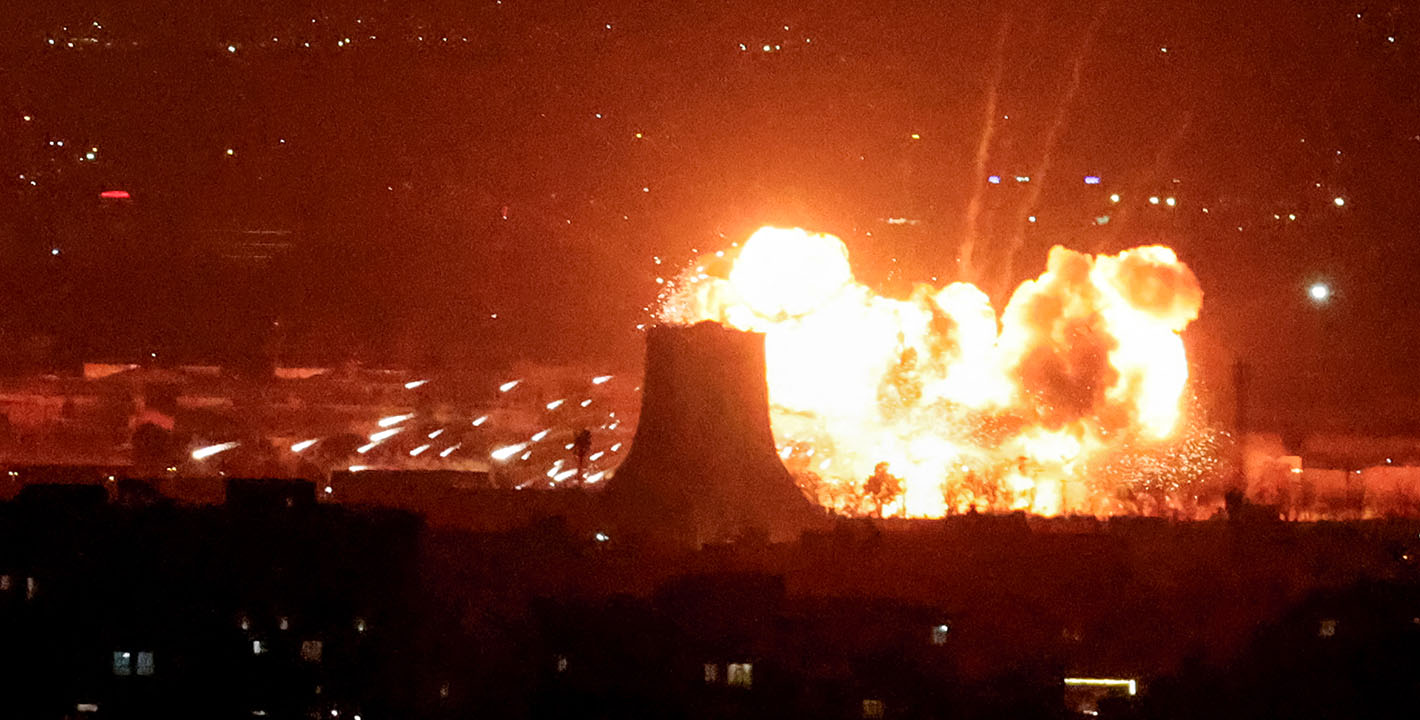
In an interview, Marc Lynch discusses his new book decrying the post-1990 U.S.-dominated order in the Middle East.

Michael Young

Because perpetual conflict enhances control, offers economic benefits, and allows leaders to ignore popular preferences.

Angie Omar
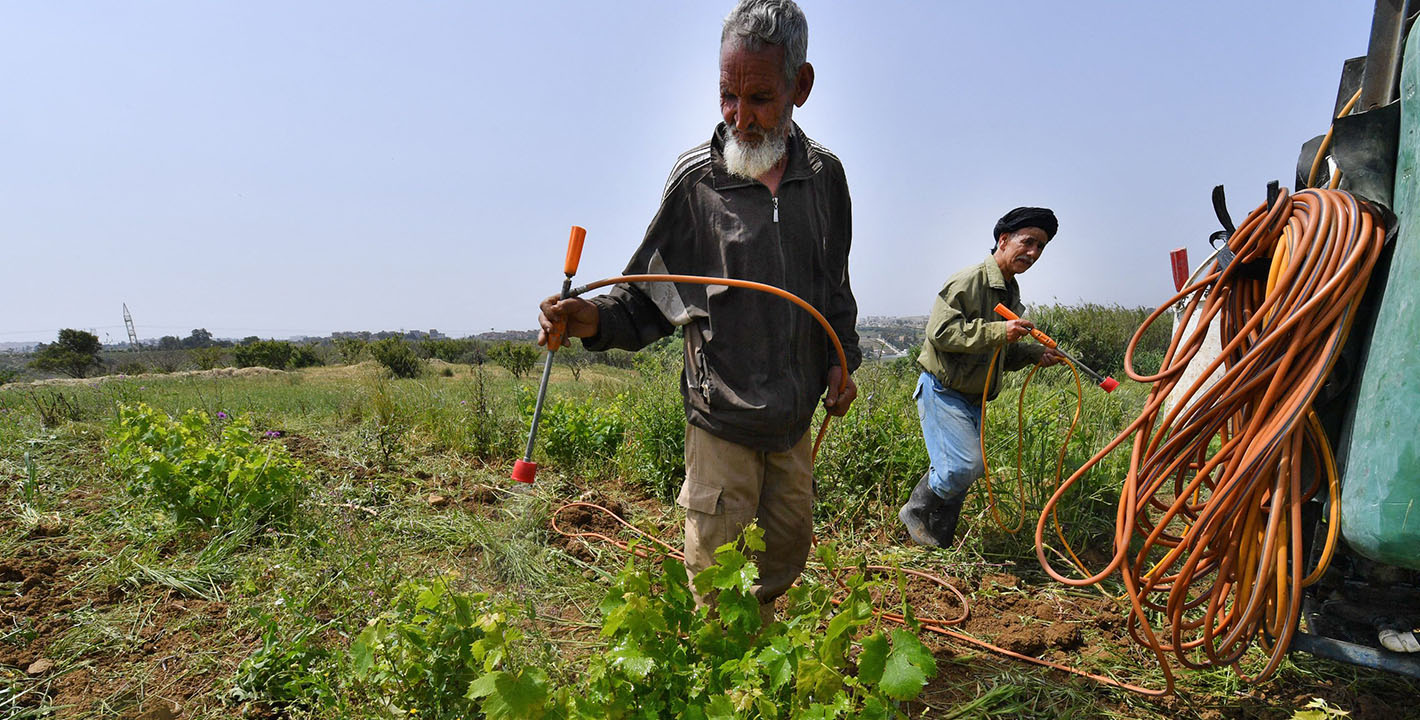
Understanding how farmers in the Oued Sahel-Soummam Valley grapple with climate change is essential for addressing the paradoxes through which adaptation, operating at both individual and institutional levels, deepens the region’s vulnerability and erodes the social fabric and agrarian identity that once defined life.

Ilyssa Yahmi
In Basra, an ethnoracial minority wages a constant struggle to assert itself in the face of marginalization.

Zeinab Shuker
The community already suffers social discrimination, so addressing inequalities requires sustained interventions.
Musaed Aklan , Mohammad Al-Saidi